
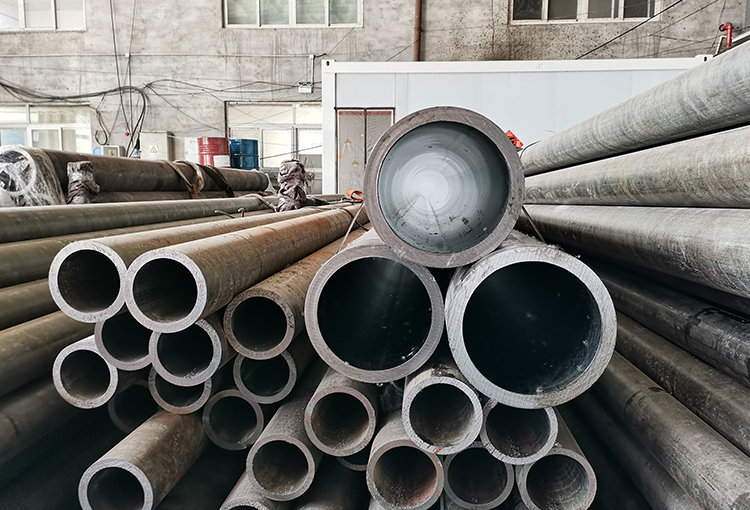
Choosing the right material for hydraulic honed cylinder tubes is critical for system reliability. Is your material choice up to the task? Let’s find out!
Hydraulic honed cylinder tubes are typically made from various grades of steel, such as carbon steel, stainless steel, and micro-alloyed steels, each offering unique properties suitable for different applications.
Understanding the pros and cons of these materials helps you make the best choice for your hydraulic systems. Let’s dive deeper into the materials most commonly used.
Common Materials for Hydraulic Honed Cylinder Tubes
Have you selected the appropriate material for your hydraulic system? Let’s explore the common materials used for hydraulic honed cylinder tubes and their distinctions.
Hydraulic honed cylinder tubes are predominantly constructed from the following materials:
- Carbon Steel:
- ST52/ST52.3: This high-strength steel is commonly employed in hydraulic cylinders due to its exceptional mechanical properties. It is particularly suitable for high-pressure applications and is specified in DIN 2391 standards.
- E355: Equivalent to ST52, this steel also meets EN 10305-1 standards. It encompasses good strength and ductility, rendering it appropriate for a broad range of hydraulic applications.
- SAE 1020: A low-carbon steel, SAE 1020 offers cost-effective benefits and is appropriate for less demanding hydraulic applications, typically utilized when fiscal constraints are paramount.
- SAE 4140 (42CrMo) : An alloy steel of robust strength, SAE 4140 provides superior tensile and yield strength, making it ideal for heavy-duty applications requiring resistance to elevated stress and pressure.
- 27SiMn: Distinguished by its high strength and commendable mechanical properties, 27SiMn is frequently featured in specialized applications mandating robust performance under high impact and load.
- Stainless Steel:
- 304: Esteemed for its excellent corrosion resistance, this material is commonly applied in environments exposed to moisture or corrosive agents. It is apropos for applications in which the prevention of rust is imperative.
- 316: Offering enhanced corrosion resistance, notably against chlorides, stainless steel 316 is frequently utilized in marine or coastal environments where corrosion is a primary concern.
- Micro-Alloyed Steels:
- 20MnV6: A carbon-manganese steel alloyed with vanadium, 20MnV6 is tailored for super high-strength applications, delivering superb mechanical properties.

SAE 4140—How Does The Chemical Composition Affect Performance in High-Pressure Applications?
Is SAE 4140 the right choice for your high-pressure application? Explore how the chemical composition increases its performance.
SAE 4140 is an alloy steel containing chromium, molybdenum, and carbon. These elements give it exceptional tensile strength and yield strength, making it ideal for high-pressure hydraulic applications requiring strength and wear resistance. The addition of chromium provides excellent resistance to corrosion, while molybdenum adds toughness and impact resistance, making SAE 4140 an excellent choice for heavy-duty use in high-pressure applications.
For more details on its properties, consult the SAE 4140 guide.
| Material | Standard | Inner Diameter (ID) | Outer Diameter (OD) | Wall Thickness | Length | Surface Finish |
|---|---|---|---|---|---|---|
| ST52 | DIN 2391 | 20 mm - 200 mm | 25 mm - 250 mm | 2 mm - 30 mm | Up to 12 meters | Honed, Ra 0.8 - 1.6 |
| E355 | EN 10305-1 | 25 mm - 250 mm | 30 mm - 300 mm | 2 mm - 35 mm | Up to 12 meters | Honed, Ra 0.8 - 1.6 |
| SAE 4140 | SAE J412 | 20 mm - 150 mm | 30 mm - 250 mm | 2 mm - 40 mm | Up to 10 meters | Honed, Ra 0.8 - 1.6 |
| SAE 1020 | ASTM A108 | 10 mm - 100 mm | 20 mm - 150 mm | 2 mm - 20 mm | Up to 6 meters | Honed, Ra 0.8 - 1.6 |
| 27SiMn | GB/T 8162 | 25 mm - 200 mm | 30 mm - 250 mm | 2 mm - 30 mm | Up to 10 meters | Honed, Ra 0.8 - 1.6 |
| 304 Stainless | ASTM A312 | 10 mm - 100 mm | 20 mm - 150 mm | 2 mm - 20 mm | Up to 6 meters | Honed, Ra 0.4 - 0.8 |
| 316 Stainless | ASTM A312 | 10 mm - 100 mm | 20 mm - 150 mm | 2 mm - 20 mm | Up to 6 meters | Honed, Ra 0.4 - 0.8 |
| 20MnV6 | Custom | 25 mm - 150 mm | 30 mm - 200 mm | 3 mm - 20 mm | Up to 8 meters | Honed, Ra 0.8 - 1.6 |
Specific Applications for 27SiMn Honed Tubes
Can 27SiMn be the answer for you? Here are a few areas where you might prefer this material compared to others.
27SiMn is preferred in certain conditions where toughness and fatigue resistance are required. It is more commonly used in high-impact and high-load applications. Applications include but are not limited to:
- Heavy machinery
- Mining equipment
- Anywhere that can be described as “severe service”
It may be desired when toughness and impact resistance are more critical than corrosion resistance, making it ideal for specialized hydraulic systems under stress.

What Are the Different Heat Treatment Processes for Various Steel Grades Used in Honed Tubes?
Are you optimizing the heat treatment for your steel? Different steels require different heat treatments to achieve the best mechanical properties.
- ST52 and E355: These steels are usually cold drawn and then stress relieved to reduce internal stresses and improve their mechanical properties and assure accurate dimensions.
- SAE 4140: Typically, SAE 4140 undergoes quenching and tempering. During quenching, the steel is heated to around 850°C and then rapidly cooled to harden it. Tempering at 550°C reduces brittleness and increases toughness, ensuring it can withstand high-pressure and high-stress environments.
The heat treatment process plays a vital role in improving the strength, hardness, and durability of hydraulic honed cylinder tubes, ensuring they can perform consistently in challenging applications.
For more details on heat treatments, check out CTS Tubes.
How Does the Cost of SAE 1020 Honed Tubes Compare to Other Materials Like ST52 and E355?
Optimizing your budget. Where SAE 1020 might save you money and where it won’t.
SAE 1020 being a low carbon steel is cheaper than the other two yet has a fairly high tensile strength and good wear resistance. While 1020 is used in less demanding applications, it makes sense if the application is more budget driven due to the lower up-front costs. However, be careful when selecting 1020, as saving in the short term may harm you in the long run with increased maintenance cost.
While E355 and ST52 are more expensive, their higher strength, durability, and solid resistance to wear and corrosion make them perfect for long-term applications.
Unfortunately, as we all know, things that are a bit more expensive tend to be a bit better.
Conclusion
In conclusion, hydraulic honed cylinder tubes are typically made from a variety of materials, including carbon steels like ST52, SAE 4140, and SAE 1020, as well as stainless steels such as 304 and 316. Each material offers specific advantages, making it essential to choose the right one based on your application’s requirements for strength, durability, and cost-efficiency. Understanding these material differences will help you optimize your hydraulic systems for maximum performance and longevity. For expert advice on material selection, visit Honingpipe.